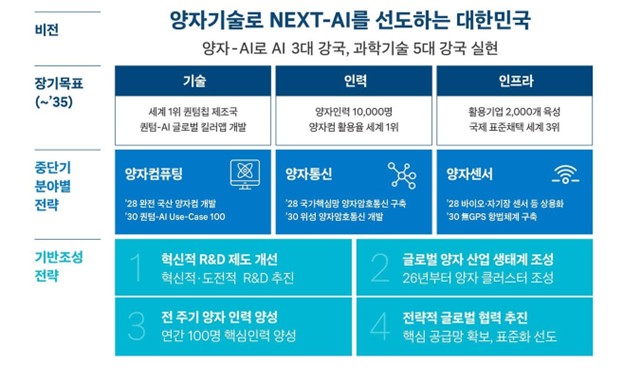
Following the era of Artificial Intelligence (AI), quantum technology has emerged as a new national strategic technology. Actions to preempt the quantum industry, which is evaluated as an innovative technology with an impact comparable to AI, have begun in earnest. On January 29, the government announced the ‘1st Comprehensive Plan for Quantum Science & Technology and Quantum Industry Promotion’ and the ‘1st Basic Plan for Quantum Clusters.’ The core goals include becoming the world’s No. 1 quantum chip manufacturer, fostering 2,000 quantum-related companies, and developing 10,000 specialists by 2035.
The comprehensive plan reflects a determination to overcome the limitations of being a latecomer by leveraging Korea’s strength as a semiconductor and ICT powerhouse. In the field of ‘Quantum Computing,’ the government will promote a ‘Manufacturing Grand Challenge’ to develop a homegrown quantum computer by 2028 and establish a Quantum-AI convergence infrastructure to preempt the application market. In collaboration with global companies such as NVIDIA, IBM, and IonQ, a ‘Quantum Algorithm Center’ will be established to actively discover ‘industrial use-cases’ that solve challenges in sectors like automotive, pharmaceuticals, and finance by 2030.
This year, the Ministry of Science and ICT will introduce the latest quantum computer to build a hybrid infrastructure linked with the supercomputer of the Korea Institute of Science and Technology Information (KISTI). IonQ has agreed to establish a joint research center in Korea and invest $5 million annually for three years. Furthermore, the ‘Quantum Technology Consultative Body’ involving leading national companies in fields such as manufacturing (Samsung, LG), telecommunications (SKT, KT), finance (KB, Shinhan), and defense (Hanwha, LIG) will be formed to create an early market.
Commercialization in the fields of security and sensors is also accelerating. In quantum communication, a nationwide quantum cryptography communication network will be established by 2028, and unhackable Quantum Key Distribution (QKD) technology will be applied to defense and financial networks. This will eventually expand to a ground-to-satellite quantum communication network alongside Post-Quantum Cryptography (PQC) technology. In quantum sensors, promising projects in the medical and defense sectors will be selected for support from prototyping to commercialization. For example, a ‘GPS-free navigation system’ that accurately identifies the location of submarines or aircraft will be developed by 2030. Other use cases include brain and heart medical diagnostics and semiconductor defect detection.
The government is focusing its policy on connecting these R&D achievements to industrialization by creating Quantum Clusters. In July this year, quantum clusters aligned with regional specialized industries will be established in five major areas (computing, communications, sensors, materials/components/equipment, and algorithms). These will serve as ‘Quantum Transformation (QX)’ hubs. Additionally, a fund will be created to nurture 2,000 startups, and a 30-year-long-term basic research system will be introduced to produce 10,000 core talents by 2035.
At the ‘Quantum Forum for the Republic of Korea’s Quantum Leap!’ held at the National Assembly on February 3rd, experts discussed specific strategies. Min-hee Choi, Chairperson of the Science, ICT, Broadcasting, and Communications Committee, stated, “Quantum technology is a disruptive innovation that will determine national competitiveness after the AI era. We will provide the legislative and policy foundation so that it does not remain confined to the lab.”
Ju-seop Shim, Director at the Ministry of Science and ICT, explained, “While major countries like the U.S. and China are linking technology development with industrialization through clusters, Korea can also create synergy by building regional clusters centered on major industrial hubs like semiconductors and bio.”
Experts at the scene emphasized private investment and talent cultivation. Sang Wook Han, Head of the Korea Institute of Science and Technology (KIST), analyzed, “The true reason quantum is gaining attention is its innovative added value when combined with other industries. This is an opportunity for Korea, which has global competitiveness in semiconductor processes and manufacturing.” KIST has been building a ‘Quantum Platform’ with the Korea Research Institute of Standards and Science (KRISS) since last year.
Eunseong Kim, Director of the KAIST Graduate School of Quantum Science and Technology, argued that victory in the technology hegemony race depends on securing innovative talent. He urged the creation of infrastructure like a national quantum fab lab where students can focus on research without fear of failure. KAIST is pushing for global ecosystem expansion through a comprehensive partnership with MIT.
Dong-gyu Kim, CEO of the quantum startup OQT, advised that a system-oriented approach where engineering and basic science work simultaneously is necessary. OQT is currently developing Korean-style neutral atom-based quantum computer technology based on global field experience.
Quantum technology has the potential to be a game-changer in almost all industries. Quantum computers, which can solve problems in seconds that would take traditional computers millions of years, are expected to change paradigms in drug discovery, new material design, and financial optimization. The government declared quantum as ‘NEXT AI’ because the combination of quantum and AI will bring a different dimension of performance improvement.
To leapfrog into a leading quantum economy by 2035, the tasks are clear: continuous investment in basic technology regardless of short-term results, policy incentives to lead private participation, and the establishment of a virtuous cycle structure centered on clusters where industry, academia, and regions communicate organically. As the world turns its eyes to the quantum era, the success of the quantum industry is expected to determine South Korea’s future competitiveness.