

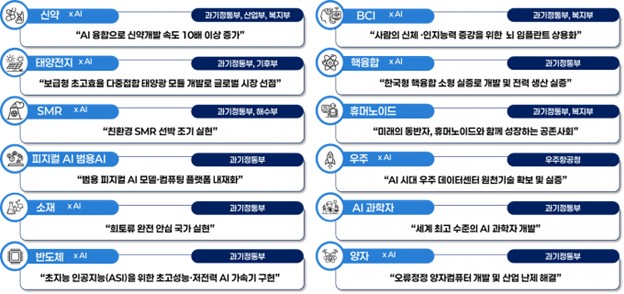
The South Korean government has finalized 12 national missions across eight key sectors aimed at solving scientific challenges through Artificial Intelligence (AI) technology. This initiative will see a massive mobilization of domestic AI firms and infrastructure providers.
Kyunghoon Bae, Minister of Science and ICT, presided over the 5th Science and Technology Ministerial Meeting at the Seoul Government Complex on the 11th. During the session, seven agendas were discussed, including the “K-Moonshot Implementation Status Report.”
The K-Moonshot strategy is a pan-national project designed to accelerate scientific innovation and address core national challenges by converging AI with science and technology.
As the U.S. Department of Energy (DOE) ramps up its “Genesis Mission” to integrate AI across its national science system, the Korean government is launching K-Moonshot to accelerate AI Transformation (AX) and tackle hurdles faced by industry, academia, and research institutes.
The 12 national missions include:
- Increasing the speed of drug discovery by more than 10 times through AI convergence.
- Early realization of eco-friendly Small Modular Reactor (SMR) ships.
- Developing world-class AI scientists.
- Developing error-correcting quantum computers to solve industrial bottlenecks.
The government aims to solve these challenges by 2035 by appointing a Program Director with specific authority and responsibility for each mission, backed by concentrated administrative and budgetary resources.
In conjunction with the mission announcement, a “K-Moonshot Strategy Partner Agreement Ceremony” was held at the Plaza Hotel in Seoul. According to the Ministry of Science and ICT, 161 companies have expressed interest in collaborating. Among them, 88 AI and infrastructure firms—including AI agent companies like LG AI Research and SK Telecom, computing infrastructure providers such as LGU+ and MangoBoost, and data firms like Persona AI and Megazone Cloud—will form the backbone of the initiative.
Major industry players such as Korea Hydro & Nuclear Power (KHNP), HD Hyundai Heavy Industries, FuriosaAI, Hanwha Ocean, and the Korea Quantum Industry Association will lead the 12 missions. They will collaborate through specific mission branches within the “K-Moonshot Promotion Team” to be formed later.
The Ministry plans to offer incentives, including research data, GPU infrastructure, and support for commercialization, to participating firms.
The meeting also approved the “AX Strategy for Four Major Science and Technology Institutes,” which focuses on building regional talent ecosystems centered on KAIST, GIST, DGIST, and UNIST.
KAIST will leverage its strength as the nation’s leading R&D hub. In collaboration with prestigious research institutions such as Government-funded Research Institutes and the Agency for Defense Development (ADD), it will be fostered as an innovation hub connecting national high-tech industry ecosystems in defense, semiconductors, and biotechnology.
GIST aims to integrate AI into regional specialized industries such as energy, mobility, and bio-health. This will be based on a super-regional cooperation model involving major local universities like the Korea Institute of Energy Technology (KENTECH) and Chonnam National University, as well as the nation’s first AX (AI Transformation) demonstration valley.
DGIST aims to secure high-reliability AX technologies in core future fields such as robotics, semiconductors, and healthcare by utilizing large-scale industrial demonstration infrastructure within the region, while also promoting the global market entry of local companies.
UNIST has been tasked with converging AX with national strategic assets—shipbuilding/offshore, aerospace, and materials industries—to establish intelligent autonomous design and production systems, thereby accelerating the creation of new growth engines for the manufacturing industry.
The four major science and technology institutes will carry out tasks in their respective regions, including enhancing industrial competitiveness, nurturing talent, activating startup hubs, and developing specialized campuses.
Specific strategies for AI application were also discussed and finalized, including the “Agricultural and Rural AI Transformation (AX) Strategy,” which integrates AI into agriculture and rural areas to resolve pressing issues and improve the quality of life for residents. Additionally, the “Status and Future Direction of Cloud-Native Transformation for Administrative and Public Systems” was confirmed, establishing a roadmap to fully transition all government information systems to cloud-based platforms by 2030.
Minister Bae emphasized, “Our future depends on how we utilize the ‘golden time’ given to us to ensure that AI acts as an opportunity rather than a threat.” He added, “Now is the time for the swift execution of these plans and for changes that can be tangibly felt on the ground.”