

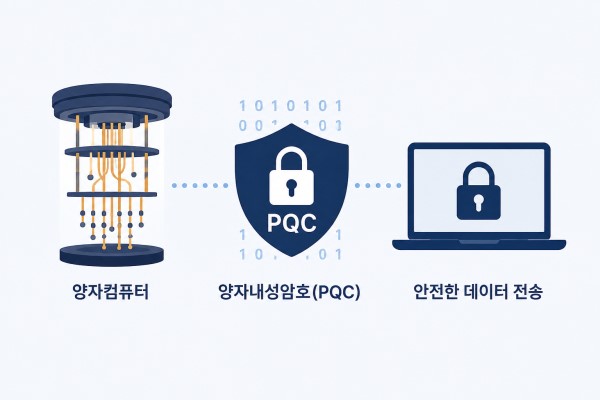
The concern that quantum computers could neutralize existing cryptographic systems is no longer remaining as a theoretical possibility. As the convergence of Artificial Intelligence (AI) and quantum computing technology accelerates, countries around the world are speeding up the establishment of ‘quantum security systems’ from the perspectives of national security and industrial competitiveness.
The South Korean government has also fully commenced operations to transition the security systems of national core infrastructures—such as public sectors, defense, finance, energy, and space—into quantum-ready systems through relevant legal amendments. A representative example is the ‘Partial Amendment to the Act on the Promotion of Quantum Science & Technology and Quantum Industry’, which passed the Cabinet meeting on the 12th.
The amendment expands quantum policies, which previously focused on research and development, to include industrialization, supply chains, security, and defense applications. It mandates that government ministries, local governments, and public institutions establish implementation plans for Post-Quantum Cryptography (PQC) and Quantum Key Distribution (QKD).
In particular, it codified the legal basis for supporting the convergence of quantum and AI. The government views ‘Quantum-HPC-AI’ technology, which combines quantum computing, High-Performance Computing (HPC), and AI, as the core of next-generation industrial innovation, including new drug development, material design, and solving optimization problems.
Furthermore, it included an impact assessment system alongside the obligation to build quantum security systems. Projects that utilize quantum technology in national core sectors—such as space, defense, telecommunications, energy, finance, and transportation—are required to assess security, safety, and reliability risks in advance.
Solutions Emerging to Aid PQC Transition
Unlike conventional computers, quantum computers perform ultra-high-speed computations by utilizing quantum mechanical properties such as superposition and entanglement. Currently, most commercial cryptographic systems are based on the difficulty of large-scale prime factorization or discrete logarithm calculations. However, concerns have been raised that if quantum computers become fully commercialized, these cryptographic systems could be decrypted within a short period.
A representative threat scenario is the ‘Harvest Now, Decrypt Later (HNDL)’ strategy. This is a method where an attacker collects and stores encrypted data in advance that cannot be decrypted at present and then decrypts it all at once in the future when sufficient quantum computer performance is secured. As warnings mount that data requiring long-term protection—such as state secrets, financial data, and defense communication information—has already entered the danger zone, the argument that the transition to PQC is urgent is gaining traction.
PQC refers to cryptographic technology based on mathematical conundrums that are difficult to decrypt even in a quantum computing environment. The National Institute of Standards and Technology (NIST) in the United States has already selected ‘CRYSTALS-Kyber’ and ‘Dilithium’ as next-generation standard algorithms and has begun global transition work. South Korea is also expanding PQC transition projects, starting with the public sector.
Recently, in the security industry, movements to implement security at the hardware level, going beyond simple software-based cryptographic applications, are also accelerating. EYL, a quantum security semiconductor company, has completed the development of a hardware-based PQC cryptographic board that combines a Quantum Random Number Generator (QRNG) with PQC. This product utilizes quantum physical phenomena to generate unpredictable random numbers and implements NIST standard PQC algorithms via a hardware acceleration method.
Existing software-based PQC has been pointed out for issues regarding computational load and processing speed. In particular, in defense communications, financial transactions, and autonomous driving environments where real-time processing is critical, performance degradation has been cited as an obstacle. Accordingly, PQC equipment utilizing dedicated hardware accelerators can secure competitiveness in the next-generation infrastructure market.
Sung-jun Cho, Executive Director of EYL, stated, “The completion of this hardware PQC board development means that South Korea has secured global leadership in the field of quantum cryptography hardware.” He added, “In alignment with the government’s enforcement of mandatory PQC, we will fully target core infrastructure markets such as public institutions, defense, and finance. As we are currently conducting demonstration discussions with several organizations, visible results will appear soon.”
Quantum Security Expanding to Space and Defense
The scope of quantum security applications is expanding beyond terrestrial infrastructure into the space domain. This is because satellite communication systems have recently emerged as core infrastructure for national security and private industries, making space security a new cyber battlefield.
KSIGN announced that it has been selected by the Ministry of Science and ICT (MSIT) and the Korea Internet & Security Agency (KISA) as the lead organization for the space sector in the ‘2026 Post-Quantum Cryptography Pilot Transition Project’ and will push forward with South Korea’s first all-section PQC demonstration project for satellite communications.
The objective of this project is to transition the entire communication infrastructure, including satellites, ground stations, and control centers, into a PQC-based system. Because it is virtually impossible to replace hardware once a satellite system is launched, long-term security design is essential.
In partnership with CONTEC, a company specializing in satellite and ground station operations, KSIGN will develop lightweight PQC libraries and hybrid PKI systems tailored to the characteristics of the space environment, such as low-performance processors, limited bandwidth, and long communication delays.
A concept drawing attention in this process is ‘Crypto-Agility’. This refers to a structure that allows for the flexible replacement of security systems without shutting down the entire system, even if new cryptographic algorithms or standards emerge in the future. Experts believe that in the quantum era, structural flexibility to respond quickly to changing threat environments will be a key competitiveness, rather than relying on a single specific algorithm.
Sang-heon Song, Principal Researcher at KSIGN, stated, “Cyberattacks on space systems have been on the rise recently, and since satellite systems cannot have their hardware replaced once launched, long-term security measures are vital.” He added, “Through this pilot transition project, we will secure the first demonstration reference of Korean-style PQC in the space sector. Together with the demanding organization, CONTEC, we will preempt global leadership in space security technology, spanning beyond public and defense sectors to the private satellite market.”
Meanwhile, the KSIGN-CONTEC consortium will execute the project until December 2026 and plans to establish the technical basis for enacting PQC application guidelines in the space sector based on the demonstration data.